Ryan Leif reports on What it Means to be Protestant: The Case for an Always Reforming Church
Tell us a bit about yourself…
I have been attending Trinity since 2021 and became a Deacon in 2025.
Book Basics
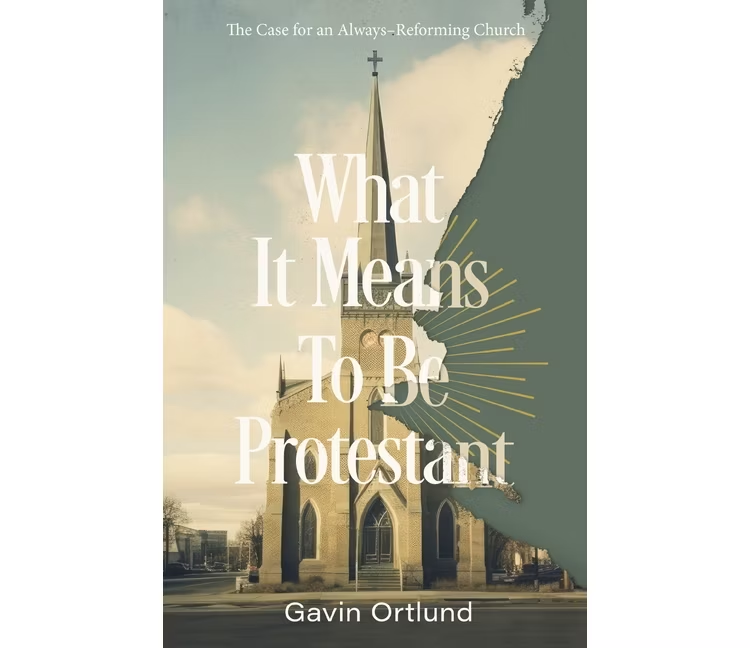
- Title: What it Means to be Protestant: The Case for an Always Reforming Church
- Author: Dr. Gavin Ortlund
- Genre: Ecclesiology, Church History
- Difficulty: Low to Moderate
Two-Sentence Summary
Dr. Ortlund provides a basis for understanding traditional Protestantism as what was intended by the reformers, working to address common misrepresentations from non-Protestant traditions, and showing how Protestantism is intended to be a retrieval of original Christian teachings. In this book, he also provides some key arguments against some of the core teachings of Roman Catholicism and Eastern Orthodoxy.
Why did you pick up this book?
I had been watching Dr. Ortlund address these issues on his YouTube channel TruthUnites for several years. He is one of the few people addressing this topic who has knowledge of the relevant subjects that is, unfortunately, lacking in many evangelical contexts today. He also approaches it in a way that is focused on seeking the truth over the triumphalism that is far too common in this area.
Key Takeaway
The first section of this book starts with the basics of what Protestantism claims to be and shows that Protestantism does not have a merely negative identity. He then addresses the claim of Roman Catholics, Eastern Orthodox, and others of being “the one true church” and what should be recognized as a valid part of the Church. He then goes over the basics of the historical background for the reformation and how the doctrine of Sola Fide was revived.
The second section is about Ecclesial authority. Here, Dr. Ortlund presents the case for the doctrine of Sola Scriptura and offers responses to many common objections and mischaracterizations. He also addresses the claims of the Papacy and apostolic succession, highlighting several historical difficulties for both.
The third section is about church history, showing how the reformation was an attempt at retrieval of classic Christianity rather than an attempt to relaunch the church. There is also a chapter examining the Catholic doctrine of the bodily assumption of Mary and one on the Orthodox practice of icon veneration, showing how both lack historical support for the first several centuries of church history.
The final chapter is addressed to those considering leaving the Protestant tradition, calling for caution and thoroughness in making such a choice.
Memorable Quote
“The great, shining glory of Protestantism-that which stands out above all else, perhaps-is its radical focus on the simplicity of the gospel. Protestantism is relentlessly and structurally focused on the all-sufficiency of the person and work of Christ himself. The non-Protestant traditions may share this value in principle. But we worry that they have inadvertently added requirements on to the gospel that Christ himself would not require.”
How did this help your walk with Christ?
Dr. Ortlund’s work has been focused on assurance of salvation and eliminating the anxieties that have been rising among many modern evangelical Christians regarding Ecclesial questions. When Catholicism, Orthodoxy, and other non-Protestant traditions have historically tied salvation with membership in their institutions, the stakes are very high when assessing their claims. It is also a great example for how to deal with debates between different Christian traditions, Dr. Ortlund exemplifies practicing charity towards those in other traditions without downplaying the importance of the differences in their teachings.
Who should read this?
Anyone who is interested in the defense of the Protestant tradition will enjoy this book. Anyone who may be feeling concerned over criticism from non-protestant traditions or is considering joining one of them should find great value.
Any cautions or limitations?
This book covers a wide array of theological and historical subjects that may seem esoteric to some. Dr. Ortlund is very skilled at making his content accessible to general readers, though some who are inexperienced in these areas may wish to start with some of his content online before reading the book.
When discussing the Roman Catholic doctrine of mortal sin, Dr. Ortlund very briefly mentions some sexual topics that parents may not want children exposed to.
Final thoughts?
Dr. Gavin Ortlund has emerged as one of the leading voices for the defense of classical Protestantism in our contemporary context. His book and other content provide a great example of how to navigate these disagreements in an increasingly fractured and hostile environment, especially online, in a way that seeks to uphold the truth while preserving charitable treatment of those on all sides.